ford F series modification

Hello bro I wish you in good condition, Right now me will tell information about ford F series modification complete with pictures and contents. But before stepping to content ford F series modification it would be good we watch first about the ford F series modification.
ford F series modification is busy wanted right now, especially ford F series modification which will I spread this is very full of content with inside information. In era a lot technology that is verysophisticated, starting from Smartphone which your have can do anything in the hands that your hold that. Be it looking for space, universe, kitchen it's all in your hand.
Article this time is part of content which has hits in the internet world that your hold . Of course the material that want me to share is very different from the other next site, very fresh and convincing.
Looks like there's no need to more detail, let's go straight to the core title, Here information ford F series modification complete with images and contents.

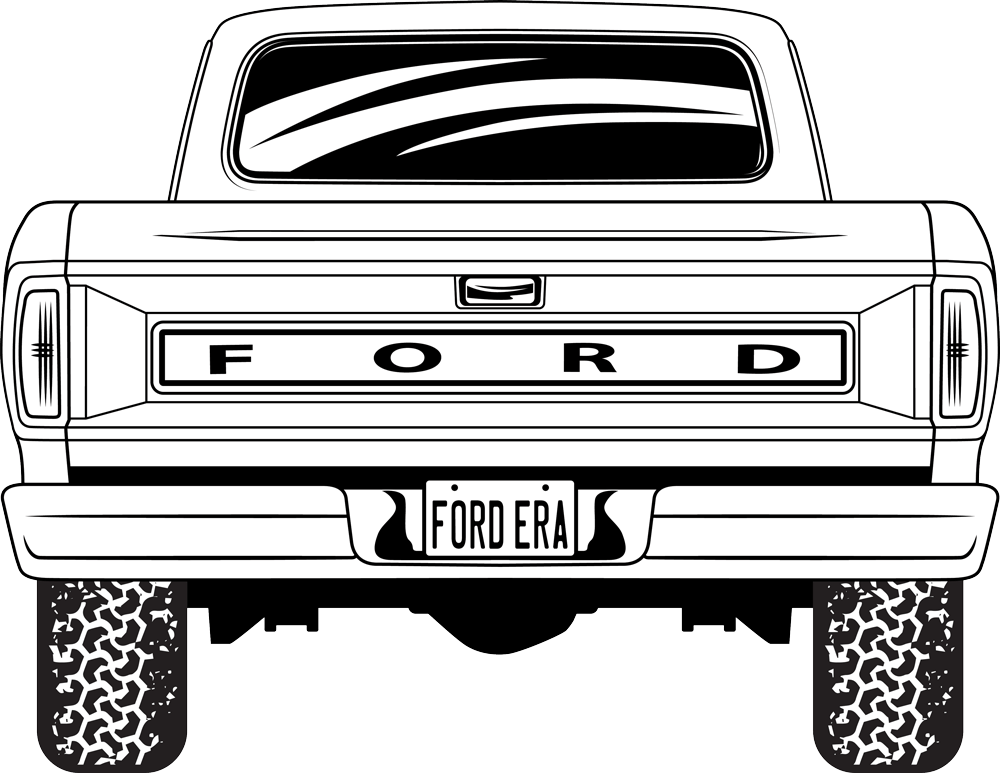
Despite how closely it resembles the previous-generation truck, Ford's best-selling vehicle is all-new for 2021, making now a good time to take a look back at all the generations of the Ford F-Series trucks. And there are a lot of them. Of course, Ford made pickups long before the first F-Series debuted in 1948, but it was that first F-1 model that kicked off a long tradition that has seen trucks go from farm-working machines to family-mobiles.
Even though Ford had produced pickup trucks aimed at private buyers before 1948, it was that year that the first F-Series debuted, developed after World War II to offer an extensive range of trucks for private and commercial customers alike. Known as the Ford Bonus-Built, the F-Series ranged from the small F-1 1/2 ton pickup and panel truck to the F-8 "Big Job" commercial truck. The chassis of the larger versions of the F-Series underpinned everything from fire trucks to buses, but it's probably the small 1/2 ton that's the most recognizable ancestor of today's Ford pickup trucks.
The arrival of the second-gen F-Series pickup introduced a new front fascia, as well as the naming scheme that has endured for decades. This generation is best remembered for introducing a sleeker and more modern look, and for introducing of the Y-Block V8 that replaced the flathead engine. The F-100 name replaced the F-1 model in this new naming scheme, serving as the smallest model, while the F-250 replaced the F-2 and F-3 trucks introduced for 1948. The F-Series gained a few new items, including the option of an automatic transmission, while also becoming a little more car-like inside thanks to sun visors and armrests.

The debut of the third-gen Ford F-Series revised the look of the trucks once again, giving the cabin a more boxy appearance, while also introducing the forward tilt to the A-pillars—something that became a signature item for later generations and was an element on much larger Ford trucks. The hood gained a flatter, clamshell design, while the cabin became wider and more spacious inside. Underneath the skin, the third-gen F-Series gained four-wheel drive in 1958, even though third-party conversions had been around for a few years as niche items.
The fourth-gen F-Series continued with the square design theme, and the truck once again grew in width and in the number of creature comforts. This generation also introduced the unibody look, eliminating the gap between the cabin and the bed, which made assembly easier and cheaper for Ford. However, the automaker dropped this look in 1964, with the two-piece design returning. That same year a new frame debuted, one that would be used through the end of the 1970s. A four-door crew cab also debuted, arriving in 1965.
One could argue that Ford trucks collectively built America. While the Model T was the car that saved small towns and big cities alike from the relentless biohazard of horse apples, it was the motorized truck that set the stage for access to goods and services, mobility, and freedom. By the time Ford gave birth to the first Ford F-Series truck in 1948, its reputation had already been burnished by 31 years of truck production. (Before the F-Series, Ford trucks were designated Model TT from 1917 to 1928, Model AA from 1929 to 1932, Model BB from 1933 to 1934, the Model 50 in 1935, the Model 67 in 1936, and no truck-specific alphanumeric designation from 1937 to 1947.)

Ford trucks earned their place in the pantheon of American life long before hot rodders started gazing lustfully at F-100s sitting forlornly in fields, longing to turn them into classic Ford hot rod trucks. Henry Ford had no inkling how hot rodders would reimagine his creations a century later, but as a farmer, he saw the need for a truck-like appliance—the Fordson tractor and the Model TT being the earliest motorized farm implements to help put America on the map. Trucks, it turned out, had utility far beyond the farm, and that includes today a myriad of industrial, military, and recreational uses.
It's fair to say that a Ford truck has played an important part in most every American's life at one time or another—mine being a 1994 Ford F-150 long-bed that I used to tow a race car. But far from being a simple beast of burden, the classic Ford F-Series truck readily lends itself to modification and customization into a classic Ford hot rod truck. When combined with its relative low cost of entry and the many performance and restoration parts available for them, the classic Ford truck is one of the most accessible hot rodding platforms in existence.
In case you're wondering, you can afford a classic hot rod Ford F-Series truck! A look at the average cost of a classic F-Series Ford truck bears this out: a first-generation Ford F1 that was built between 1948 and 1952 goes anywhere between $1,600 for a parts vehicle to about $22k for a running model in excellent condition (using a six-category scale where "parts car" is condition 1 and "excellent" is condition 4). A highly popular second-generation F100 (1953 to 1956) starts around $1,800 for a parts truck and commands an average of $29,250 for one in excellent condition. Going up to a third generation (1957 to 1960) averages $2,760 for a parts car to an average of $31,050 for a Flareside in excellent condition. The workhorse 1961 to 1966 fourth generation F100 averages $1,040 for a parts car and $31,050 for one in excellent condition. Fifth generation F100s average $1,280 to $14,850 you get the picture. If you can find a less-desirable platform or stake-bed model, prices go even lower.






Thats it, great isn't the article?. Hopefully with content ford F series modification this, the aggan the problem can be resolved and entertained thanks to article this.
All of me, Hopefully discussion about ford F series modification those can be useful for all of you readers. Ending word. Arigato for everything.

Post a Comment for "ford F series modification"